Beyond the Chatbot: Architecting Autonomous Customer Success
For years, Customer Success (CS) has been trapped in a reactive cycle. CS managers spend their days firefighting, responding to tickets, and manually identifying at-risk accounts. The promise of scaling personalized, proactive value realization has remained just that - a promise.
The rise of generative AI offers a path forward, but most implementations are stuck at the "chatbot" stage - a faster way to answer FAQs, but not a fundamental shift in how value is delivered. The true transformative potential lies in moving from passive assistance to active, intelligent execution: Agentic Customer Success.
The Reactive Trap of Traditional CS
The core problem with traditional CS models is that they are human-bottlenecked. As your customer base grows, your ability to provide proactive, high-touch engagement scales linearly with headcount.
In this model, "proactive" often means a generic email blast. True proactive success - identifying a usage pattern that indicates a future churn risk and intervening with a tailored solution before the customer even complains - is impossible to do at scale.
The Agentic Advantage: From Support to Success
An agentic approach fundamentally changes this dynamic. Unlike a chatbot that waits for a question, an Autonomous Customer Success Agent is designed to:
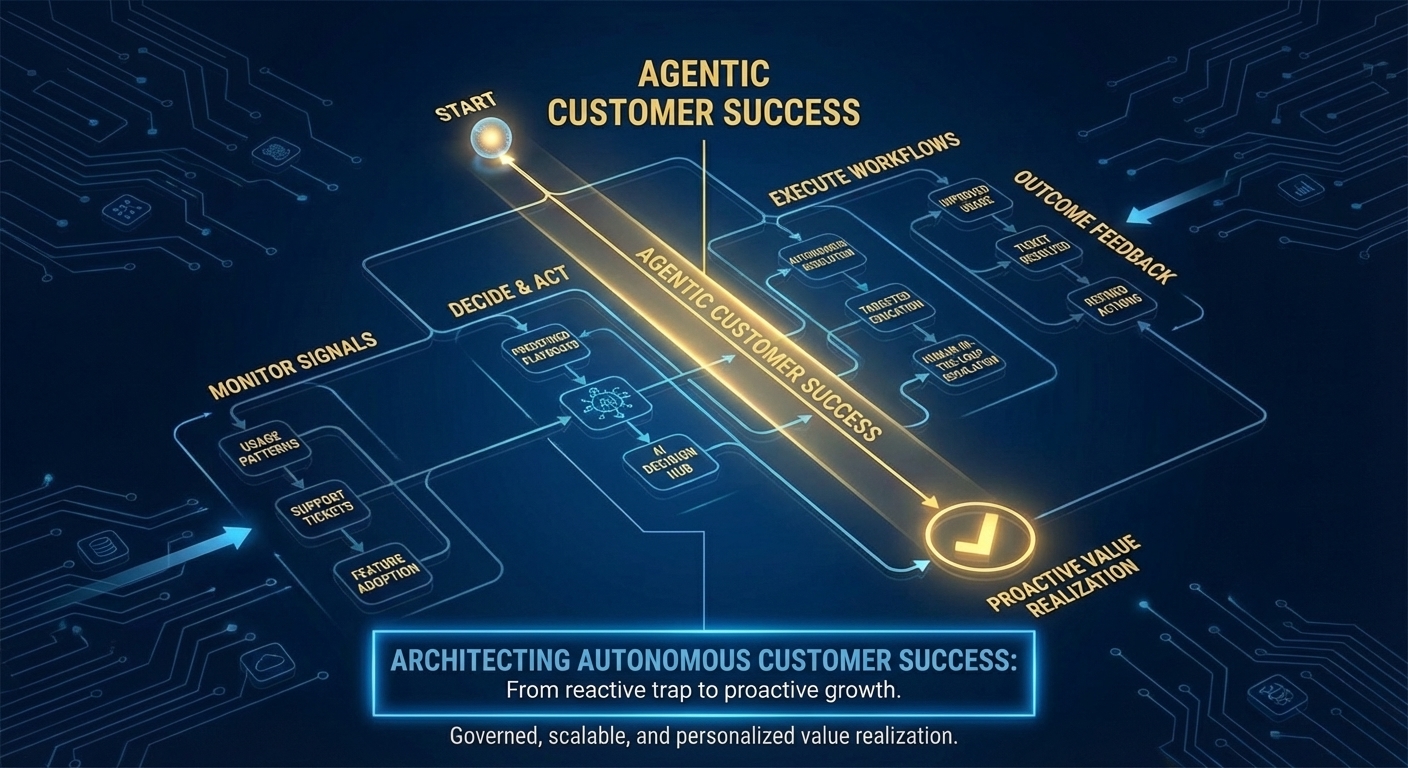
- Monitor Signals: Continuously ingest and analyze customer data streams (usage patterns, support tickets, feature adoption) to identify opportunities and risks.
- Decide & Act: Autonomously determine the best course of action based on predefined playbooks and goals.
- Execute Workflows: Proactively resolve issues, send targeted educational resources, or trigger a human-in-the-loop (HITL) escalation for complex scenarios.
Architecting the Autonomous CS Loop
A successful agentic CS strategy requires a new architectural approach. It's not just about having a powerful AI model; it's about building a governed, closed-loop system.
1. The Signal Layer (Input)
This is the agent's sensory input. It connects to your CRM, product analytics, and support ticketing systems, constantly scanning for triggers - like a drop in a key usage metric or a specific type of support ticket.
2. The Agentic Hub (Intelligence)
This is the brain. Based on the input signals, the agent consults its goal (e.g., "Increase adoption of feature X") and its knowledge base to determine the optimal action.
3. The Action Layer (Output)
This is where the agent executes. It might autonomously:
- Resolve: Directly fix a common technical issue by calling an API.
- Educate: Send a personalized email with a relevant tutorial video.
- Escalate: Route a complex, high-value customer issue to a human CS manager with a prepared briefing.
4. The Outcome Layer (Feedback)
The loop closes by measuring the impact of the action. Did the customer's usage improve? Was the ticket resolved? This data feeds back into the system, allowing the agent to refine its future actions.
Governance is Key to Scalable Autonomy
For an agent to be trusted with customer interactions, governance must be baked in. This means establishing clear guardrails: what the agent can say, what actions it can take autonomously, and the exact criteria that trigger a human handover.
By architecting a governed, agentic CS loop, organizations can finally break free from the reactive trap and deliver proactive, personalized value at scale - turning customer success into a true driver of growth.