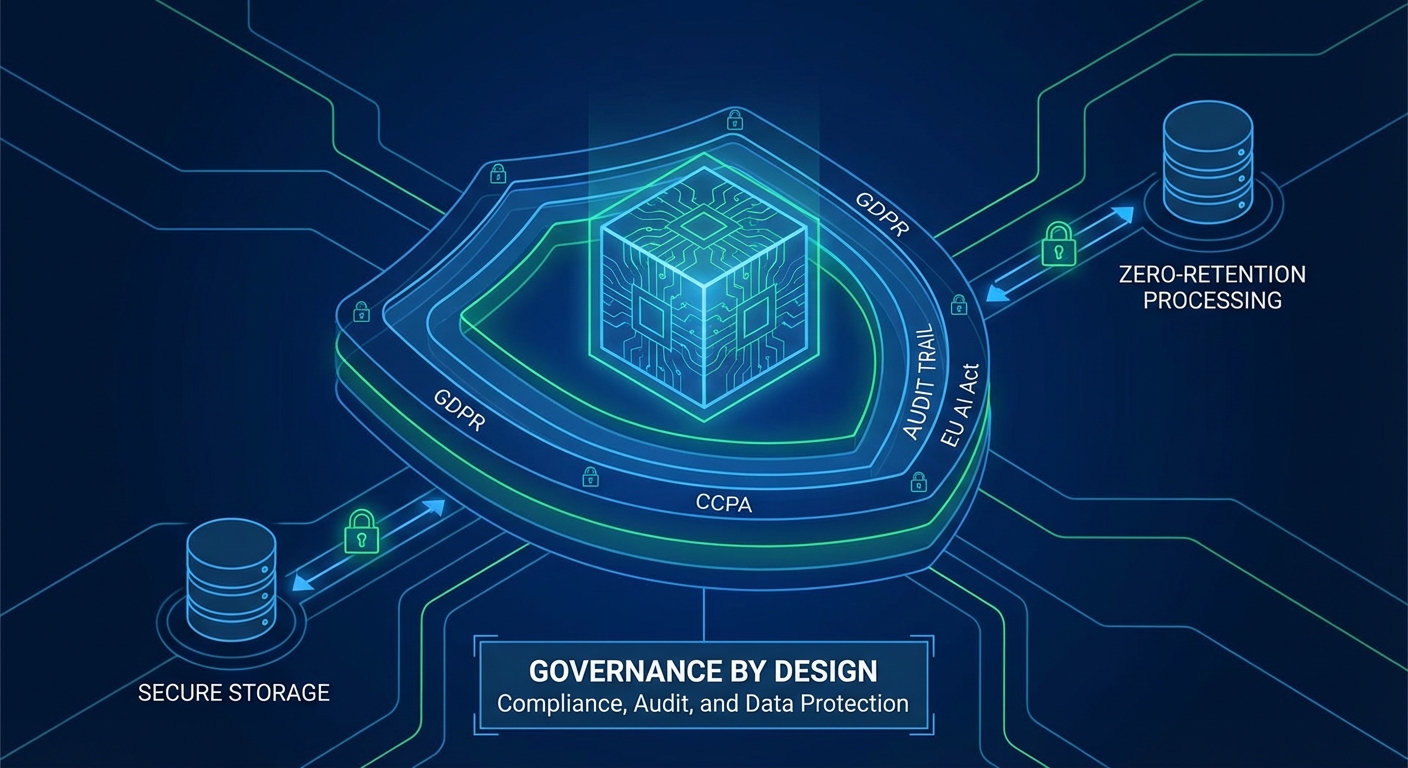
Governance by Design: The Missing Link in Scalable Enterprise AI
We are witnessing a strange dichotomy in the enterprise AI landscape. On one side, frantic experimentation with frontier models. On the other, a near-total paralysis in deploying those models into mission-critical production workflows.
The reason for this paralysis is clear: boards and risk committees recognize that an ungoverned AI agent is a liability generator.
For enterprises in regulated sectors - finance, healthcare, legal, insurance - "move fast and break things" is not a viable strategy. If AI is to move from a novelty to a core operational pillar, governance cannot be an afterthought module bolted on at the end. It must be baked into the architectural substrate.
This is the principle of Governance by Design.
The "Black Box" Liability Problem
The fundamental challenge with probabilistic AI models is their unpredictability. When an AI is given agency - the ability to execute tool calls and modify systems - that unpredictability becomes an unacceptable enterprise risk.
If an autonomous agent denies a loan application, misclassifies patient data, or violates a GDPR forgetting request, the organization is legally and relationally responsible. "The model hallucinated" is not a defensible legal strategy.
The Three Pillars of a Governed Agent Platform
To cross the chasm from pilot to production, enterprise AI architecture must satisfy three non-negotiable requirements that reflect the rigor of Big 4 audit standards.
1. Deterministic Guardrails over Probabilistic Models
You cannot rely on prompt engineering ("Please do not violate GDPR") to ensure compliance. Prompts are suggestions; architecture is law.
A governed platform uses deterministic code layer that sits between the LLM and your systems. This layer enforces hard constraints - checking permissions, redacting PII, and validating outputs against policy logic - before any action is executed. The model suggests the action; the governance layer permits it.
2. Immutable Audit Trails and Explainability
If a human employee takes a high-value action, there is a paper trail. AI agents must be held to a higher standard.
Every step in an agent's reasoning chain - the data it accessed, the tools it called, the intermediate decisions it made - must be logged in an immutable audit trail. This allows compliance teams to retrospectively reconstruct the "why" behind any automated decision, satisfying regulatory inquiries.
3. Zero-Retention Data Architecture
For many enterprises, sending sensitive IP or customer PII to a model provider for training is a non-starter.
Governance by design requires a "zero-retention" architecture. Data should flow through the reasoning engine to provide context for the immediate task and then immediately vanish. It should never be stored at rest by the model provider or used to train future foundational models.
Conclusion: Trust is an Engineering Challenge
Trust in enterprise AI is not achieved through sentiment or marketing. It is achieved through rigorous engineering. By prioritizing governance by design, enterprises can stop fearing autonomous agents and start utilizing them to drive unprecedented operational efficiency.