The Agentic Shift: Why Moving Beyond Copilots is an Enterprise Imperative
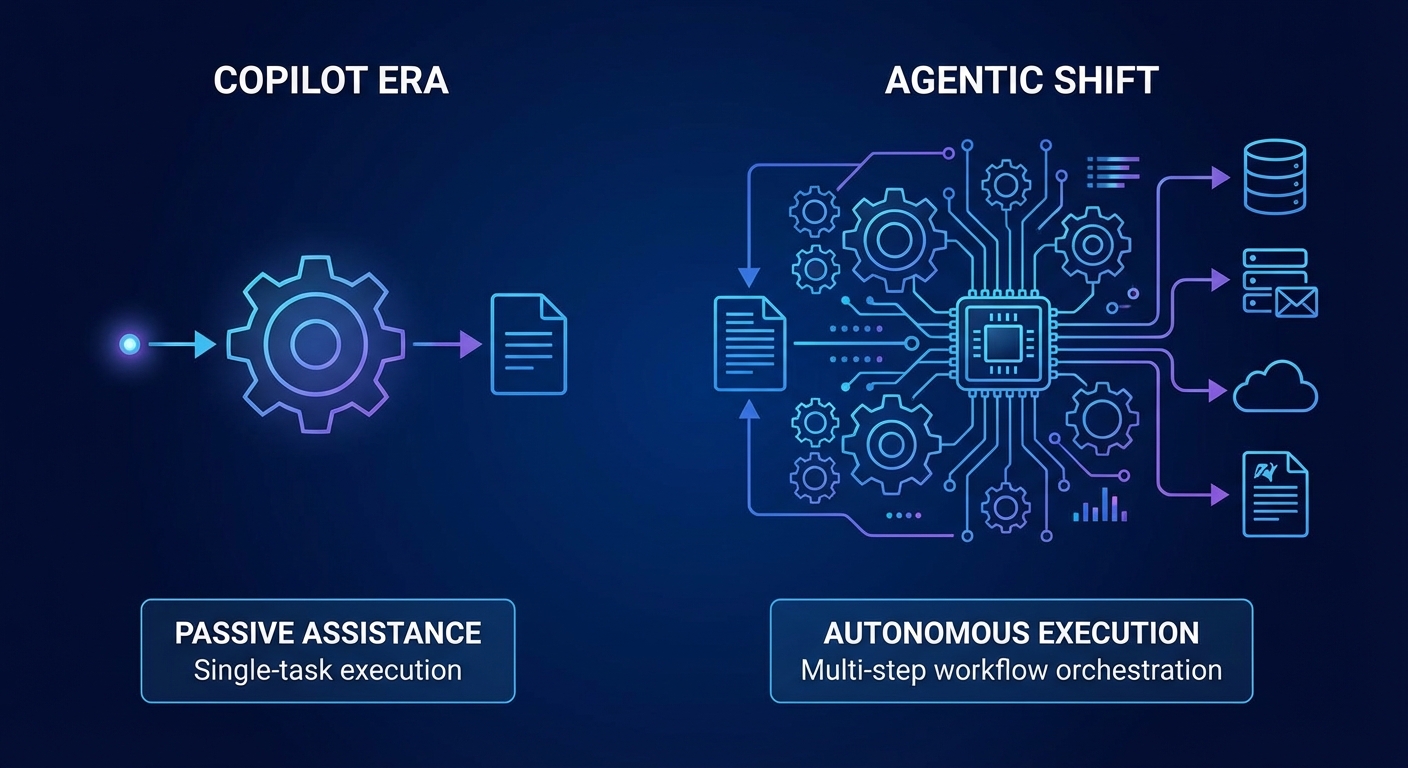
The first wave of generative AI in the enterprise was defined by the "Copilot" - a passive assistant designed to summarize data, draft emails, and answer questions. It was a necessary phase for adoption, driving individual productivity gains.
But for the C-suite, the Copilot era is already hitting a ceiling.
Enterprises are realizing that summarizing a problem is not the same as solving it. The next frontier - and the source of genuine competitive advantage - lies in moving from passive assistance to active, intelligent execution. This is the era of Agentic AI.
The limitation of the "Chat" interface
The fundamental limitation of current enterprise AI deployments is their reliance on human initiative. A chatbot waits for a prompt. It provides an output, and then it stops. The human remains the middleware, constantly copy-pasting information between the AI and the actual systems of record (CRM, ERP, HRIS).
This structure inherently limits ROI. You aren't automating the process; you are merely accelerating one step of it.
Defining the Agentic Enterprise
Unlike a chatbot, an AI agent doesn't just respond; it pursues goals.
An agentic system can be given a high-level objective - such as "resolve this customer dispute based on our SLA policy" or "reconcile these vendor invoices" - and autonomously plan a sequence of actions to achieve it. It can query databases, invoke APIs, update records, and solicit human approval only when necessary.
The shift is profound:
- Copilots provide information for humans to act upon.
- Agents take action based on human-defined goals and guardrails.
The "Execution Gap"
Why haven't enterprises deployed agents en masse already? The answer is risk.
Asking an LLM to write a poem carries zero risk. Asking an LLM to execute a financial transaction or modify customer data carries immense liability.
Most enterprises are currently stuck in an "execution gap." They have the ambition to automate complex workflows, but they lack the infrastructure to do so safely. They cannot afford "hallucinations" that result in erroneous database writes or regulatory breaches.
Bridging the gap with governed architecture
The transition to an agentic enterprise requires more than just powerful models. It requires a new architectural layer designed for governed execution.
To move beyond copilots safely, enterprises need platforms that treat trust as an engineering constraint, not a sentiment. This means:
- Auditable reasoning chains (knowing why the agent took an action).
- Hard-coded compliance guardrails (preventing the agent from taking prohibited actions, regardless of the prompt).
- Native Human-in-the-Loop (HITL) interfaces (seamlessly handing off control for critical decisions).
The organizations that win in the next 24 months will not be those with the cleverest prompt engineers. They will be the organizations that deploy the infrastructure necessary to let AI agents safely do real work.