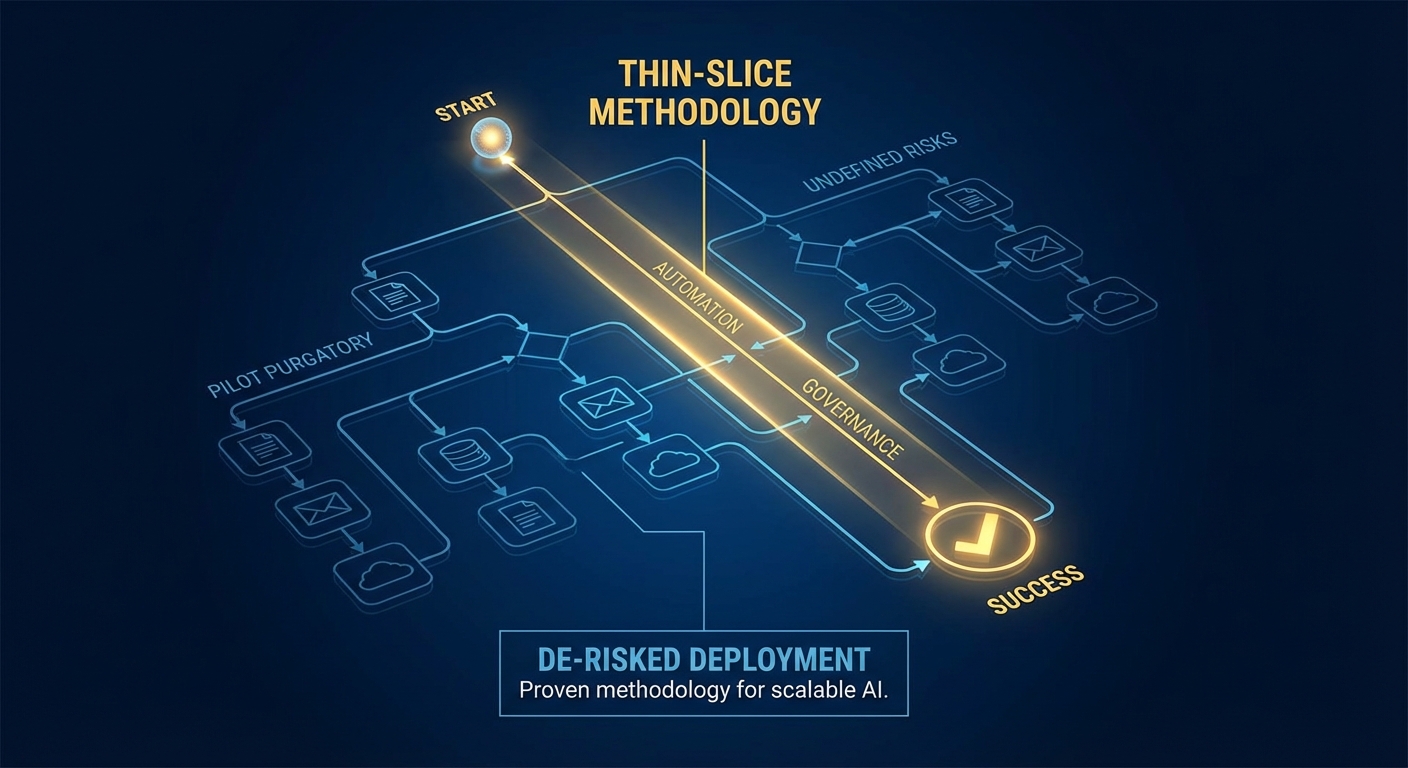
Escaping Pilot Purgatory: The "Thin-Slice" Methodology for Governed Agent Deployment
Enterprise AI initiatives frequently suffer from a fatal flaw: ambition without architecture. Organizations attempt to "boil the ocean," aiming to revolutionize entire departments in a single, massive transformative project.
The result is predictable: "pilot purgatory." Endless strategy meetings, security reviews that stall due to undefined risks, and proofs-of-concept that never touch production data because they cannot be trusted.
Given the velocity at which AI capabilities are evolving, long, drawn-out deployment cycles are obsolete before they finish. The alternative - the path to actual production - is the "Thin-Slice" Methodology.
Defining a Thin-Slice Deployment
A Thin-Slice deployment rejects broad, shallow applications of AI (like giving everyone a generic chatbot assistant). Instead, it focuses deep on one specific, high-friction workflow.
It is a vertical slice through your operations: one department, one defined process, one measurable outcome, and crucially, one set of compliance constraints.
The goal is not to transform the company overnight. The goal is to safely deploy a governed agent into a production environment to prove that autonomous execution works within your unique constraint environment - before scaling horizontally.
The De-Risked Path to Autonomous Execution
Here is the proven methodology for moving an enterprise agent from concept to governed production.
Phase 1: Strategic Selection & Governance Mapping
We don't start by asking "What can AI do?" We ask, "Where is the friction?" We identify processes that are:
- High volume and repetitive.
- Rules-based but require slight cognitive judgment (e.g., matching an invoice to a PO where fields don't perfectly align).
- Currently creating bottlenecks for skilled human workers.
Once selected, we don't just map the workflow steps; we translate your compliance policies into technical guardrails. We define exactly what systems the agent can "see" (read access), what tools it can "touch" (write access), and configure necessary PII redaction protocols.
Phase 2: Configuration, Not Retraining
A common enterprise mistake is assuming you need to retrain foundational models on your data. This is rarely necessary and often introduces new risks.
Instead, the Thin-Slice approach focuses on configuring the agent platform. We connect the agent to your live data streams via secure connectors and implement the deterministic governance layer that sits between the model's reasoning and your systems of record.
Phase 3: Deployment in "Suggestion Mode"
Crucially, the agent is initially deployed with its "action hands" tied. It connects to live data and runs the workflow real-time, but instead of executing the final step (e.g., sending the email, updating the ERP), it routes its proposed action to a human for one-click approval.
This phase is essential for building organizational trust. Audit logs validate that the agent's reasoning and adherence to guardrails match human performance standards, with zero operational risk.
Phase 4: Graduating to Bounded Autonomy
Once the audit logs confirm the agent is performing accurately in Suggestion Mode, the training wheels come off.
We enable "bounded autonomy." The agent begins executing the standard workflows autonomously. However, the platform maintains rigorous oversight. If the agent encounters an edge case, a low-confidence scenario, or a transaction above a certain threshold, it automatically reverts to Human-in-the-Loop (HITL) mode for resolution.
Proven Blueprint Before Scale
The Thin-Slice methodology turns AI adoption from a massive gamble into a controlled, measurable process. By proving the governance model works for one slice, you establish the architectural blueprint - and gain the necessary organizational buy-in - to scale agentic workflows across the enterprise.